The AI Illusion 1.27 — Border Codes
AI, Migration and the Movement of People


Executive Summary: How AI Is Transforming UK Border Enforcement
Artificial intelligence (AI) is dramatically reshaping how nations govern movement, manage borders and enforce immigration laws. The UK increasingly depends on AI as an invisible gatekeeper — from small boat detection in the English Channel to biometric screening at Heathrow.
These algorithmic systems decide who enters, who is scrutinised, and who is turned away. This analysis examines the rapidly evolving use of AI for migration control, its operational strengths and challenges, and how it underpins the UK’s goal of securing a technologically enhanced border.
Borders as Dynamic Systems: The Shift from Physical Checkpoints to AI-Driven Enforcement
Physical barriers and checkpoints once defined borders. Today, borders function as dynamic, AI-powered enforcement ecosystems.
The UK’s complex geography, its extensive coastline and numerous ports, is maintained through biometric capture, predictive analytics and layered surveillance infrastructure operating around the clock.
European projects such as BorderForce and CRiTERIA illustrate this shift globally, integrating drones, satellite imagery and real-time AI processing to detect and respond to movement across vast terrain.
“We are witnessing the emergence of border AI systems that disappear the migration experience into a black box of surveillance and automated suspicion.”
— Petra Molnar, Migration Researcher & Legal Analyst
Legal scholar Petra Molnar calls this model an automated panopticon; a constant, automated surveillance regime that transforms migrants into classified data points.
Smart Ports and AI-Driven Processing: Accelerating Lawful Passage and Detection
AI fortifies the UK’s air and sea borders by increasing efficiency, speed and filtering capacity.
Biometric eGates at Heathrow and Gatwick use facial recognition and passport chip readers to speed up processing. As of 2024, over 100 gates operate daily, managing thousands of travellers.
Predictive scheduling tools forecast peak passenger flows using AI analytic models of footfall, staffing availability and flight data — improving workforce deployment while maintaining compliance.
AI cargo scanners monitor X-ray images of containers at ports like Felixstowe and Dover. Built under the Accelerated Capability Environment (ACE), these systems spot anomalies related to trafficking and concealed persons.
⚠️ Ports now act less like border checkpoints and more like algorithmic filters, embedding detection into cargo and pedestrian flow.
Environmental sensors, enhanced with AI, register unusual patterns of CO₂ and thermal activity inside sealed containers, enabling real-time interdiction of concealed individuals.

Surveillance of the Porous Coastline: AI’s Role in Maritime Border Security
The UK coastline, stretching over 11,000 miles, remains difficult to monitor — especially amid rising small boat crossings.
Autonomous surveillance towers, manufactured by Anduril Industries and deployed on the South-East coast, scan for marine activity using radar, thermal and electro-optical sensors, operating autonomously 24/7.
The Home Office’s investment in these towers reflects deepening reliance on sensor-based border enforcement.
AI-equipped drones augment patrol coverage with heat detection and predictive vessel tracking.
Predictive analytics tools process weather, tides and prior crossings to forecast probable landing points, optimising the mobilisation of response assets.
Satellite-AI fusion systems identify “dark vessels” attempting to evade radar, giving enforcement agencies a pre-emptive edge.
These multi-layered systems operate even when no prior digital identity exists for the individuals being tracked.

Algorithmic Screening and Migration Decisions: Improving Efficiency with AI
AI now plays an active role in evaluating immigration applications and claims, improving document scrutiny and case throughput.
The Home Office has launched pilot plans for facial age assessment tools, aimed at verifying age claims of unaccompanied minors, using AI trained on millions of facial images.
Natural Language Processing (NLP) software evaluates consistency across statements in asylum applications, cross-referencing time, place and factual detail markers.
Document verification algorithms analyse biometric chip data, microprinting, and metadata to identify tampering or forgeries in identity submissions.
Disrupting Smuggling Networks: AI as a Pre-Emptive Enforcement Tool
AI technologies are being used upstream to disrupt the networks that facilitate irregular migration.
Machine learning tools scrape public platforms and encrypted messaging apps for smuggling-related imagery, payment requests, route descriptions and recruitment information.
Image analysis software flags suspicious photographs, correcting for obfuscation, and feeds alerts into national threat databases for response escalation.
Rather than reacting at the border, AI allows UK agencies to target smuggling networks before they move people physically.
This approach reframes border protection as a continuous supply chain disruption targeting facilitators and routes, not only migrants themselves.

Operational Challenges and Strategic Vision: Balancing Risk and Control
Despite robust deployment, operational risks remain.
False positives can mislead resource allocation and reduce trust in systems, necessitating continual model training and refinement.
The market is dominated by private defence firms whose algorithms are often proprietary, limiting public scrutiny or redress.
The UK’s Legal Migration and Border Control Strategy (2024–25) outlines a vision for a contactless digital border, rolling out automated checks and electronic travel authorisations (ETAs) starting in 2024.
A digital border by the end of 2025 is the end goal, “counting people in and counting people out” using biometric status and facial analytics.
🧠 As automation deepens, so do questions about accuracy, governance and the social consequences of digital exclusion.
Molnar argues that AI border tools lack direct oversight and enable systems of classification that migrants themselves cannot perceive or contest.
UK Case Study — The Invisible Border: Sensors and Algorithms in Action
"Britain’s border is not a fence but a network of sensors and algorithms."
The UK’s enforcement toolkit reflects how AI technologies merge physical and digital border infrastructure:
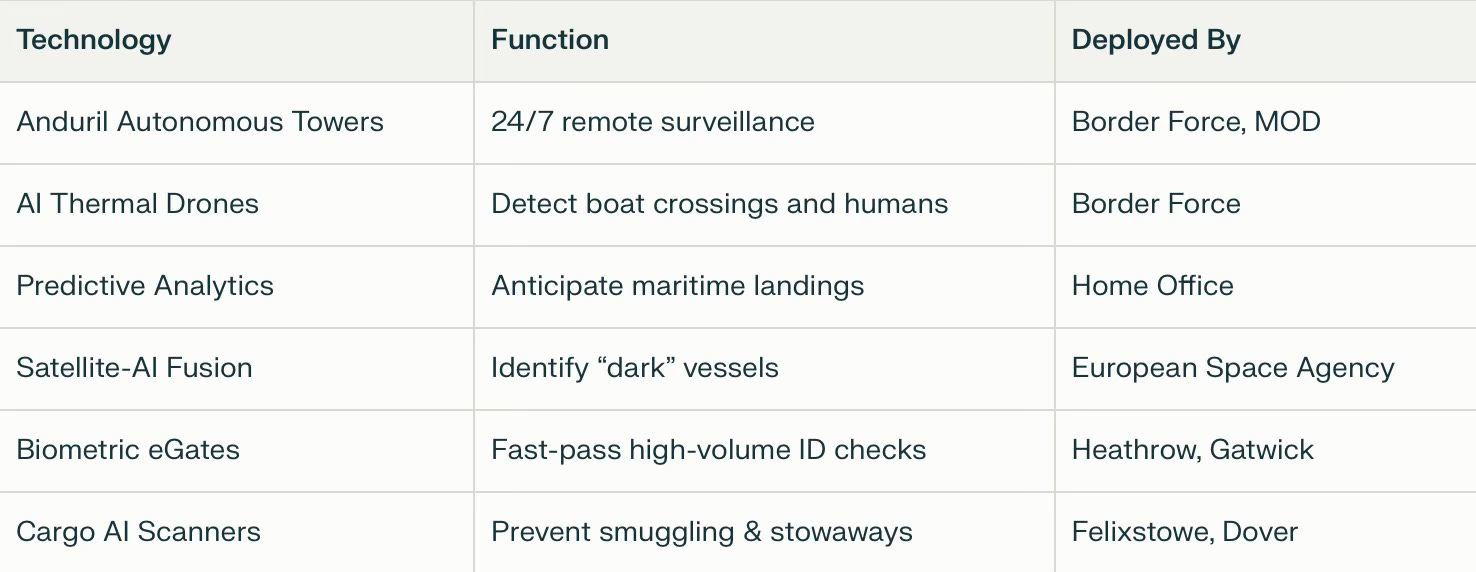
These systems form a decentralised enforcement layer — not a fence, but what Molnar calls a “network of sensors and algorithms”.
Preparing for Climate Displacement and Programmable Mobility
AI is also being programmed to predict mass displacement caused by climate shifts.
Environmental disruption models anticipate population movement from sea-level rise, drought and resource scarcity.
Future mobility systems may issue “climate visas” through automated scoring protocols; regulators are already exploring prototypes.
Programmable mobility may replace nationality with AI-derived reputational and risk scores.
These developments point towards an expanded role for AI in controlling not just how people move, but if they are allowed to move at all.

Conclusion: Borders Rewired by AI for Enforcement
Borders are no longer lines printed on passports or maps. They are networks of software, sensors and active risk calculations.
For the UK, this means movement is governed by machine learning models, biometric databases and real-time threat assessments consistent with a national policy to lower unauthorised migration.
While AI improves processing speed and enhances detection coverage, limited transparency raises important questions about algorithmic power and redress.
The future of migration enforcement is likely to be software-governed. The question is who audits the system, and whether its decisions will remain enforced, challengeable, comprehensible or humane.
References
: UK Home Office. Legal Migration and Border Control Strategy (2024–25).
: European Commission. CRiTERIA and BorderForce Projects Overview (2025).
: Molnar, P. “AI and the Automated Panopticon in Migration Management.” Migration Studies Journal (2024).
: Heathrow Airport Operations Report (2024).
: UK Border Force and ACE Collaboration on Cargo AI Screening (2025).
: Anduril Industries. UK Maritime Surveillance Tower Contract Brief (2024).
: Home Secretary’s Statement on Contactless Digital Border (2025).
: The PIE News. Digital Border Deadline Extended to December 2025.