Trained to Be Abandoned
Britain is producing the midwives it cannot employ, while running wards it cannot staff

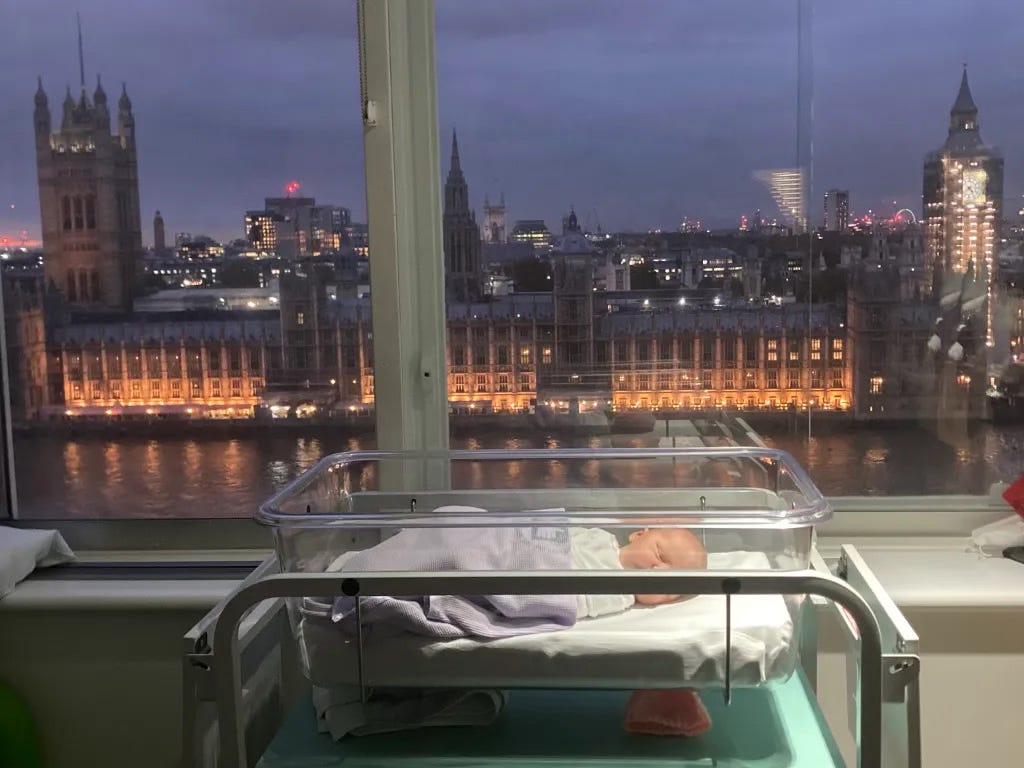
A note from the author: I completed this piece a fortnight ago. It has been sitting under consideration at a national newspaper since the end of April. This morning Lisa Haseldine’s powerful Spectator piece on Britain’s maternity crisis only strengthens the argument I make below. We are looking at the same scandal from adjacent angles. She writes from the patient experience. I write from the structural paradox behind it: Britain is training midwives it then refuses to employ, while running maternity wards that cannot find the staff to keep women and babies safe. The louder the voice on this, the better. I am no longer waiting for editorial permission to put this argument into the world.
Thirteen babies die every day in the United Kingdom before, during, or shortly after birth. One family destroyed every two hours, day after day, year after year. In 2015, the government pledged to halve the rates of stillbirths, neonatal deaths, and maternal deaths by 2025. That target has been missed on every measure. Maternal mortality has not fallen. According to the latest MBRRACE-UK data, the overall UK maternal mortality rate has risen by 20 per cent when the 2022 to 2024 period is compared with 2009 to 2011. The direct maternal death rate increased by 52.3 per cent between the 2017 to 2019 and 2020 to 2022 reporting periods.
The charity Sands estimates that over 800 babies a year could be saved with better care. The Royal College of Obstetricians and Gynaecologists found that for nearly three-quarters of preterm babies who died in 2016 and 2018, different care might have led to a different outcome.
These figures are not from a country struggling to build basic healthcare infrastructure. They are from one of the wealthiest nations on earth. And the explanation, when you hear it from the people closest to it, is not complicated. It is unforgivable.
The Paradox
Britain is simultaneously producing midwives it cannot employ and running maternity wards it cannot staff. That is the central absurdity of the crisis, and it is documented in the Royal College of Midwives’ own data.
A February 2026 RCM survey found that 31 per cent of newly registered midwives who had obtained their Nursing and Midwifery Council pin were unable to secure a midwifery position. Of those unable to find a role, 61 per cent were not working in any job at all. Others had taken positions in retail, hospitality, cleaning, and prison services. Even among those who had found midwifery roles, 55 per cent were on fixed-term contracts rather than permanent ones. Over 80 per cent of students still in training reported they were not confident of finding a job on qualification.
Now set that alongside the other side of the ledger. England has an estimated shortage of 2,500 midwives. Those still in post are working an estimated 100,000 hours of unpaid overtime every week. A 2025 RCM survey found that 87 per cent of midwives believe their unit is not safely staffed. In 2022, 57 per cent were considering leaving the profession. Burnout is endemic, sickness absence rampant, and the attrition rate devastating.
The picture is not that midwives have left the profession en masse. Many have stayed, but they have adapted. Increasing numbers of experienced midwives move from shift-based ward work to antenatal clinic, community, or specialist roles as soon as they can. Some of this is healthy specialisation within a mature profession. In other cases it is flight from a clinical setting that has become unsustainable. The distinction matters less than the aggregate effect. The acute wards where babies are actually delivered are losing the experienced workforce they need, to specialisation in one direction and to attrition in the other, while the new midwives who should be replacing them cannot get jobs.
What the Ward Looks Like at 2am
Statistics do not capture what understaffing means in practice. The rota shows adequate cover on paper. In practice, midwives increasingly dread night shifts, not because of the work itself, which they trained for with passion and at considerable personal cost, but because of the brutal arithmetic of what they are asked to deliver. Emergency protocols exist, and the NHS-wide 2222 call will bring a response team within minutes on any ward in the country. But when everyone is already stretched, backup becomes a matter of redistributing crisis rather than resolving it. The calmer, continuous attention that good midwifery requires evaporates.
The NHS has a tool called Birth Rate Plus, a workforce calculation system that quantifies how many midwives a ward requires based on the acuity of its patients. A senior midwife at a tertiary teaching hospital described the reality bluntly.
“Most of the time it says we need fifteen midwives. We are working with twelve.”
What that shortfall looks like, she recalled from a Sunday day shift some years ago, was being one of two midwives asked to cover nine recently delivered high-risk women while the other nine midwives on shift were tied up in labour rooms. The normal postnatal ratio on her ward is one midwife to seven. Each of the two on that shift carried more than four women, all of them high-risk. The factors that produced that shift are now routine.
To plug staffing gaps, hospitals are increasingly forced to close their low-risk birthing units and pull the midwives onto the main obstetric ward. Women who had chosen a low-intervention birth experience find themselves on the high-risk unit instead, even where the clinical care they receive is unchanged. A woman whose birth plan has been quietly dismantled does not appear in any official statistic.
The Care Quality Commission’s national review of maternity services from 2022 to 2024 found that 65 per cent of maternity units in England were rated either inadequate or requires improvement overall. Staff reported that care had become task-driven rather than patient-centred. Nearly all services reported “red flag” staffing incidents, the NHS’s own term for something going dangerously wrong with midwifery numbers. In some trusts, these incidents were not even being properly recorded.
The View from Florence Nightingale’s Hospital
For a sense of what the recruitment collapse looks like in practice, consider Guy’s and St Thomas’ NHS Foundation Trust. This is the hospital where Florence Nightingale founded the world’s first professional nursing school in 1860. It employs a nursing and midwifery workforce of around 9,000 people across five of the UK’s best-known hospitals, including the Evelina children’s hospital and the Royal Brompton. It should be among the most active employers of midwives in the country.
In early April 2026, the trust advertised a single preceptorship post for newly qualified midwives. That advertisement closed on 6 April. It has not been replaced. At the time of writing, the live nursing and midwifery vacancy list at Guy’s and St Thomas’ contains seven posts. Not one of them is a midwifery role. Every listed vacancy is a senior specialist nursing post: tissue viability, sleep apnoea research, paediatric cardiology, paediatric emergency, paediatric palliative care, surgical care, and rheumatology.
The reason is not mysterious to those working inside the trust. A senior midwife at a tertiary teaching hospital described the mechanism. Since August 2025, Guy’s and St Thomas’ has operated under an external recruitment freeze as part of a wider budget-control exercise that the NHS calls succession planning. Where posts can be filled internally, by promotion or lateral move, they are. External recruitment is sharply restricted and requires justification. The freeze cannot apply to entry-level Band 5 midwifery roles in the absolute sense, because there is no internal pool below Band 5 from which to promote. But the number of Band 5 posts advertised at any one time is now governed by tight financial controls, and the broader recruitment cycle is smaller than it was. When the autumn preceptorship round opens in the coming weeks, the number of posts offered will be whatever the trust can afford, not what the wards need.
Across the rest of central London the picture is much the same. Chelsea and Westminster, Imperial, UCLH, and King’s College Hospital have no Band 5 midwifery vacancies live on NHS Jobs at the time of writing. Barts Health and Homerton, to their credit, do recruit more actively, but the London total runs to a handful of posts against a graduating cohort numbering in the hundreds.
There is a recruitment cycle to this, and the picture will improve in the coming weeks as the summer round opens. But the RCM survey that found almost a third of newly registered midwives without a post was conducted in February, after one round had already concluded. The cycle exists. It is simply inadequate to the scale of the need, and it runs on budgets set by trusts that are themselves in crisis.
When Intervention Replaces Care
One consequence of the midwifery crisis is visible in a statistic that would have been unthinkable a generation ago. In England, 42 per cent of all births are now by caesarean section, up from 29 per cent just five years ago and from 3 per cent in the 1950s. When instrumental deliveries (forceps and ventouse) are included, over half of all births in 2023 involved medical intervention. For women over 40, a caesarean is now the most common way for their baby to be born.
The causation is more complex than the caesarean rate alone suggests, and the honest picture does midwifery no favours. Modern pregnancies are genuinely more complex than those of a generation ago, with older mothers, higher rates of obesity and diabetes, and IVF enabling pregnancies that in earlier decades would not have occurred. Women from Black, South Asian, and other global-majority backgrounds are physiologically predisposed to conditions including hypertension and gestational diabetes, and remain several times more likely to die in childbirth than their white counterparts. Some of the rise in surgical delivery reflects genuine clinical need in a patient population whose acuity has increased.
A second dynamic is now equally important. Obstetrics is the most litigated specialty in the NHS, and maternity claims account for a disproportionate share of the service’s total legal liability. After a decade of inquiries, midwives and obstetricians practise under conditions in which any hesitation, any ambiguity on a foetal heart-rate trace, any change in maternal observations, tips the clinician towards intervention.
“We would rather intervene early than too late. If there’s any whiff that we don’t like something, we’re probably going to intervene.”
Defensive practice is not a moral failing. It is a rational response to the environment in which clinicians now work, shaped by the Shrewsbury and Telford findings, the East Kent report, and the consistent message that a worse outcome will be punished more severely than an unnecessary intervention.
Compounding all of this is a third factor. In the wake of the Ockenden review, women reading the press now approach birth with a rational wariness of midwifery-led care. The 2015 Kirkup report into Morecambe Bay had already criticised a culture of “normal birth at any cost.” Ockenden sharpened that critique into a national narrative. Increasingly, women are requesting caesareans outright, wanting the certainty of a date and a degree of control over a process in which trust has been lost. This is not a purely middle-class phenomenon. It crosses demographic lines, and it feeds back into the clinical pressure on theatre space and staffing. The harder it becomes for midwives to provide continuous, confidence-building care, the more women rationally conclude that surgery is safer. The harder it becomes to sustain midwifery-led practice, the further the profession retreats.
The post-Ockenden press coverage, well-intentioned in its scrutiny of maternity failures, has had the additional effect of vilifying the individual midwives trying to hold the system together, many of whom now describe reading their morning newspaper as a daily act of professional self-harm.
“We are trying so hard in a system that is failing us. Midwives are being seen as bad people, and we’re not. We’re good people working in a really difficult system.”
The international evidence on caesarean rates is unambiguous. A Lancet series on optimising caesarean use found that national rates above 10 to 15 per cent bring no population-level benefits and may actively harm healthy mothers and babies. Each subsequent caesarean carries greater surgical risk than the last because of scar tissue and adhesions, and increases the likelihood of uterine rupture in future labours. The public health consequences of surgical birth becoming the British norm are significant and accumulating, yet they attract remarkably little political attention, perhaps because the individual tragedies are hidden inside statistics while the systemic drift is easy to miss.
What Other Countries Manage to Do
It does not have to be this way, and the proof is not theoretical. In the Netherlands, independent midwives have long been the primary caregivers for healthy pregnant women, working in community practices and providing continuity of care from the first antenatal appointment through to the postnatal period. Pregnancy and birth are treated as normal physiological events, not medical conditions requiring intervention. Obstetric specialists are involved only when complications arise. The Dutch model has consistently been associated with low intervention rates and strong outcomes.
The Nordic countries follow a similar philosophy. In Denmark and Sweden, autonomous midwives employed by national health services provide the front line of maternity care, and these countries are routinely cited for their excellent perinatal outcomes. A Cochrane review of midwife-led continuity models found they were associated with a 24 per cent reduction in preterm births and a 16 per cent reduction in foetal and neonatal deaths, compared to fragmented models of care. Women were more likely to have a spontaneous vaginal birth, less likely to need intervention, and reported significantly higher satisfaction.
Britain once aspired to something like this. The NHS was founded on the principle that midwives, not surgeons, should be the primary caregivers for normal pregnancies. The 2016 Better Births review explicitly called for continuity of midwifery care as the standard model. That vision has not merely stalled. It has been dismantled by a decade of underinvestment, and the women and babies of this country are paying for it in the most brutal terms imaginable.
The Promotion Trap
Among the details that rarely appear in official reports, one stands out for what it reveals about the depth of institutional dysfunction. Experienced midwives are refusing promotion.
Band 7 roles on the NHS career ladder come with responsibility for rota organisation, incident reporting, governance paperwork, and administrative duties that those who have experienced them describe as crippling. They also mean a move from shift work to a Monday-to-Friday pattern, which sounds attractive until midwives realise it strips them of the unsociable-hours payments that bring their take-home salary close to a liveable level in London. The modest notional pay increase does not begin to compensate. And the CQC found that when midwives were promoted, trusts frequently failed to replace them in their clinical roles, simply redistributing the workload onto those who remained.
The result is a profession in which the most experienced practitioners actively avoid advancement, in which leadership is associated not with professional fulfilment but with institutional misery, and in which the career structure itself is a driver of attrition. Many experienced midwives continue to pick up clinical shifts at weekends after moving to non-clinical daytime roles, partly because they need the money and partly because they do not want to lose the clinical skills they spent years developing. It is not a sustainable arrangement.
A Decade of Scandal, a Decade of Reports
The political response follows a pattern so consistent it amounts to a form of negligence in its own right. Morecambe Bay was investigated. The Kirkup report, published in 2015, identified staffing as a root cause. Shrewsbury and Telford, the largest maternity scandal in NHS history, was investigated. The Ockenden report, published in 2022, found that over 200 babies had died or been left brain-damaged across two decades. Staffing was a root cause. East Kent was investigated the same year. Babies died. Staffing was a root cause. Nottingham is still under review. Leeds had its maternity services rated “inadequate” by the CQC in June 2025, with staff afraid to raise concerns for fear of a blame culture. A full independent inquiry was granted in October 2025.
In between, a 2022 parliamentary report on maternity staffing concluded that “crisis mode is now the norm.” The government announced £127 million to boost the workforce. Three years on, the situation is measurably worse. The money was absorbed by a system that cannot translate funding into filled posts because the posts themselves are frozen at trust level by budget constraints.
In June 2025, Wes Streeting announced yet another investigation, a rapid national review chaired by Baroness Amos. By early 2026, the Baroness reported that the problems were “much worse” than she had anticipated when she accepted the role. The final recommendations are due this spring. Four years after the parliamentary report diagnosed the crisis, we remain in the “investigating” phase. The women giving birth tonight on understaffed wards across this country cannot wait for the spring.
Who Owns This Failure?
Responsibility is layered across so many institutions that it effectively belongs to nobody, which is itself the problem.
The Treasury sets the funding envelope. NHS England controls workforce planning and has consistently failed to match the number of midwives it trains to the number of posts available. Individual trust boards make hiring decisions under budget constraints imposed from above. The previous Conservative government abolished the midwifery study bursary in 2017, introduced annual tuition fees of £9,250, and presided over a decade of spending restraint during which the midwife shortage grew to 2,500. Three-quarters of midwifery students now graduate with debts exceeding £40,000 to enter a profession that may not employ them and, if it does, will likely burn them out within a few years.
Wes Streeting, the current Health Secretary, has shown more personal engagement with the issue than most of his predecessors. He chairs the National Maternity and Neonatal Taskforce. He has met bereaved families and spoken publicly about the horror of what they described to him. In August 2025, he acknowledged that it was “absurd” to train thousands of nurses and midwives only to leave them without jobs, and announced a “Graduate Guarantee” package including £8 million to convert maternity support worker posts into Band 5 midwifery roles. Within months, over 80 per cent of student midwives due to qualify reported they were “not confident” of finding a job. The underlying disease, trust-level recruitment freezes driven by insufficient funding, remained untreated.
In fairness to Streeting, Labour inherited a set of Treasury constraints and NHS finances that narrow the options available to any Health Secretary in the short term. The structural problem is not of his making. But the public spending choices made in the autumn 2024 Budget and in subsequent fiscal events have not redirected meaningful resources toward maternity workforce expansion, and the recruitment freezes across London trusts have persisted through his first fourteen months in office. Continuity of purpose between governments does not absolve the current one.
Being moved by the stories of bereaved families is not the same thing as solving the problem. And no Health Secretary, however sincere, can hire midwives that trusts cannot afford to pay.
A Spending Decision Disguised as a Policy Problem
This crisis is not awaiting the next taskforce report. The evidence has been gathered, reviewed, published, debated, and gathered again for over a decade. Every investigation reaches the same conclusion. The obstacle is money, not knowledge.
What is required is not mysterious. Ring-fence funding for midwifery posts and protect it from trust-level budget raids. Guarantee preceptorship places for every newly qualified midwife, because training people to degree level and then offering them shifts in coffee shops is not workforce planning. Reform Band 7 roles so progression means clinical leadership, not administrative drowning and a pay cut. Forgive midwifery student debt for those who complete a minimum period of NHS service, as the Royal College of Midwives has proposed.
None of this is mysterious, and none of it requires another inquiry. What it requires is a decision by the Treasury that the lives of newborn children and their mothers are worth spending money on.
In countries where midwifery is properly funded, properly structured, and properly respected, mothers and babies do better, intervention rates are lower, and the workforce does not collapse in on itself. We know this because the evidence has been available for decades, from the Netherlands, from Scandinavia, from the Cochrane reviews that successive British governments have commissioned and then ignored.
The senior midwife I spoke to in the course of writing this was asked what she would say if Wes Streeting could spend only a few minutes with her. Her answer was not about policy.
“Come and spend one shift. Shadow a newly qualified midwife on a busy night. Don’t follow me, because I’m experienced and I can get by. Follow the Band 5 who is overwhelmed, overstretched, trying to be supported by equally busy colleagues. And then tell me what you have to say.”
Thirteen babies a day. The midwives who could help are stacking shelves or applying for jobs in the prison service. The midwives who remain are alone on night shifts, making choices no clinician should ever have to make. Meanwhile, somewhere in Whitehall, another investigation is being drafted, more recommendations are being prepared, and a generation of qualified, passionate, debt-laden midwives is discovering that nobody in a position of power cares enough to give them a job.
The question is not whether politicians know about this. They know. The question is whether they will do anything before the next scandal names the next dead babies.
The record suggests they will not.
David McCreadie is a former British Army artillery officer and spent thirty years in equity capital markets in the City of London. He now writes and consults independently and is at work on a book, The AI Illusion, examining the societal consequences of artificial intelligence.
References and sources
Mortality and morbidity data
MBRRACE-UK (Mothers and Babies: Reducing Risk through Audits and Confidential Enquiries across the UK). Saving Lives, Improving Mothers’ Care. Annual reports, National Perinatal Epidemiology Unit, University of Oxford. The 52.3 per cent increase in direct maternal deaths compares the 2017 to 2019 period against 2020 to 2022; the 20 per cent overall rise compares 2009 to 2011 against 2022 to 2024.
Sands (Stillbirth and Neonatal Death Charity) and Tommy’s Joint Policy Unit. Saving Babies’ Lives Report series, 2023 to 2025. The figure of thirteen babies dying every day before, during, or shortly after birth is drawn from ONS and MBRRACE-UK combined data.
Royal College of Obstetricians and Gynaecologists. Each Baby Counts programme reports, covering preterm neonatal deaths 2016 to 2018.
Five Times More. Campaigning organisation documenting maternal mortality disparities affecting Black women in the UK (fivetimesmore.org).
Workforce and recruitment
Royal College of Midwives. State of Maternity Services reports, 2022, 2023, 2024, and 2025.
Royal College of Midwives. RCM highlights midwives are “exhausted, overstretched and burnt out.” December 2025 briefing.
Hunter, B., Fenwick, J., Sidebotham, M., and Henley, J. (2019). Midwives in the United Kingdom: Levels of burnout, depression, anxiety and stress and associated predictors. Midwifery, Volume 79.
NHS Jobs and Guy’s and St Thomas’ NHS Foundation Trust vacancy listings, accessed April 2026.
Regulatory and independent reviews
Care Quality Commission. State of Care reports, 2022 to 2024.
Kirkup, B. (2015). The Report of the Morecambe Bay Investigation. The Stationery Office.
Ockenden, D. (2022). Findings, Conclusions and Essential Actions from the Independent Review of Maternity Services at the Shrewsbury and Telford Hospital NHS Trust.
Kirkup, B. (2022). Reading the Signals: Maternity and Neonatal Services in East Kent. Department of Health and Social Care.
Baroness Valerie Amos. Rapid National Review of NHS Maternity and Neonatal Services, interim findings 2026. Final report due spring 2026.
House of Commons Health and Social Care Committee. The Safety of Maternity Services in England. Fourth Report of Session 2021 to 2022.
Clinical evidence and international comparisons
Sandall, J., Soltani, H., Gates, S., Shennan, A., and Devane, D. (2016). Midwife-led continuity models versus other models of care for childbearing women. Cochrane Database of Systematic Reviews, Issue 4.
The Lancet Series on Optimising Caesarean Section Use (2018).
National Maternity Review (2016). Better Births: Improving Outcomes of Maternity Services in England. NHS England.
OECD Health Statistics on caesarean section rates by country, 2023.
Policy and government
Department of Health and Social Care. National Maternity Safety Ambition (2015).
Department of Health and Social Care. Announcement of £127 million maternity workforce funding (2022) and subsequent Graduate Guarantee package (August 2025, £8 million).
Nursing and Midwifery Council. The Register: March 2026.
Primary interview
A senior midwife at a tertiary teaching hospital, interviewed by the author on 21 and 23 April 2026. Quoted material used with permission. Anonymity preserved at her request.